
Turns out, people do want to talk about recalls. Before ICPHSO 2026, we wrote that recall was the subject nobody really wanted to talk about. We may have to revise that slightly.
Two days in Brussels produced a lot of conversations about what happens when products go wrong. It turns out recall isn’t quite the unwanted dinner guest we thought. Perhaps just the relative nobody mentions until they arrive, at which point everyone discovers they have a story about them.
The sessions we mostly missed
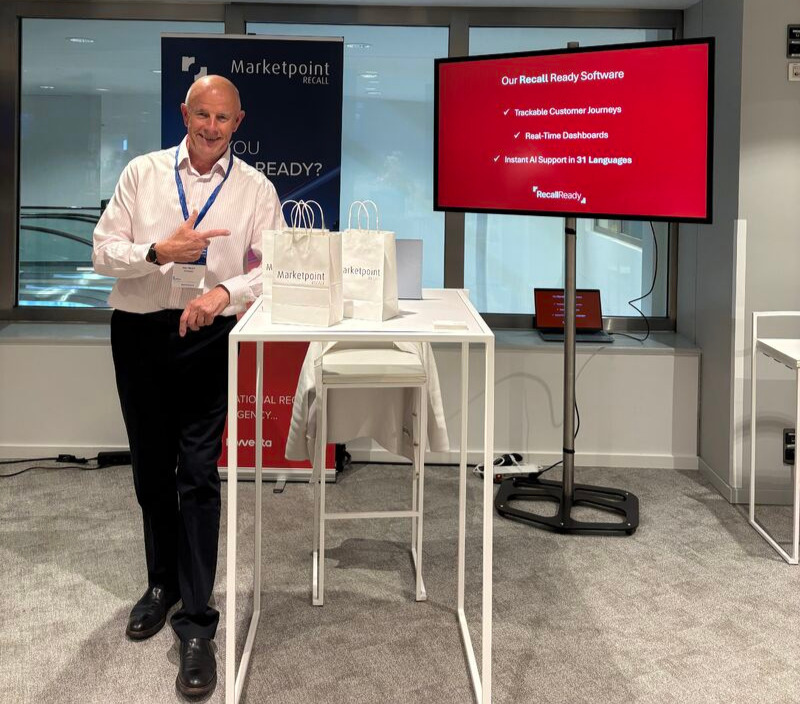
We arrived at ICPHSO with good intentions and an agenda full of sessions we wanted to hear. Then the doors opened. The downside of a busy stand is that our carefully planned conference itinerary didn’t survive very long.
However, we loved the session on ‘Using AI Tools to Detect Unsafe Products Online: Emerging Approaches for Market Surveillance and Recall Effectiveness’. We know firsthand that AI is being applied to recall communications, triage and case handling, so seeing the conversation extend further into surveillance and identifying unsafe products was encouraging.
Although we were sad to miss many of the other sessions as we would have liked, there are worse problems to have at an exhibition than being too busy talking to people. And those conversations produced a few observations of their own.
Passports, people and the bigger picture
The biggest one for us was the Digital Product Passport. Within the product safety community, the direction of travel is well understood. Outside it, there is a much bigger question waiting to be answered: what does any of this mean to the person who actually buys the product?
The technical and regulatory machinery can be built. But somebody still has to explain to consumers what a product passport is, why they should care about it and, crucially, what they are expected to do with it. That feels some way off.
For those of us working in recalls, this is particularly interesting. Better product information and traceability could have obvious implications when something goes wrong. But a passport only becomes useful to consumers if people understand it and engage with it. There is a sizeable consumer education job ahead.
Our second takeaway was simpler. It is good to get out of your own bubble. Product safety is a broad church. Lawyers, regulators, manufacturers, retailers, compliance teams and technology businesses can spend their working lives tackling different pieces of the same puzzle. ICPHSO was a useful reminder that the macro objective is shared: make products as safe as possible and, when problems do occur, limit the harm.
The third takeaway was rather more personal. One prospective customer came to the stand specifically looking for Marketpoint Recall because they wanted to discuss using the platform. No introduction. No chasing them around Brussels with a brochure. They sought us out.
For a business working hard to change how organisations think about recall readiness, that was a satisfying moment. The message is travelling.
Finally: book early. Our final lesson requires rather less analysis. ICPHSO gets busy. Very busy.
See you next time
We’ve already booked for next year. Hopefully we’ll manage to attend a few more sessions. Although, after this year, we’re making no promises.
Thanks to everyone who stopped by the stand, everyone we caught up with and all the new faces we met in Brussels. It was good to spend two days among people tackling the same fundamental problem from different directions.
And yes, we’re still happy to talk about recalls. Apparently, quite a few of you are too.